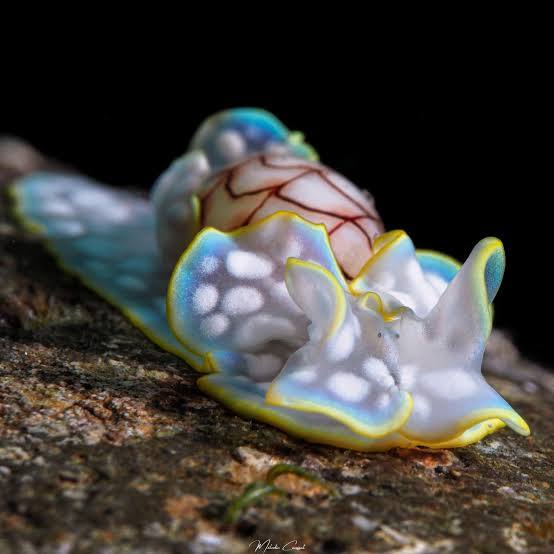
Micromelo Undatus
> Length: 3cm
> Distribution: South Africa to Japan and Hawaii.
> Description: A distinctive species with undulating brown lines crossed with two other spiral lines. Inhabiting the soft substrates and algal turf areas of rocky reefs; not commonly found.
Hydatina physis
> Length: 4cm
> Distribution: South Africa, Red sea, Arabian Sea, Maldives, Philippines to Hawaii, Australia and New Zealand.
> Description: Like most members of this group, this shelled sea slug has a large body, which cannot be fully retracted into its shell. Hydatina physis has well-developed sensory mechanisms which it uses to feed on polychaete worms of the family Cirratulidae. Often found in shallow waters, usually not deeper than 5 m, crawling over or through sandy substances. The egg mass of this species is attatched to the sand by a mucous thread.

Hydatina amplustre
> Length: 4cm
> Distribution: South Africa to Hawaii and Australia
> Description: A specialised predator feeding on polychaete worms. A shallow water species found on reefs with a mix of sand, rock, and turf algae.

Bullina lineata
> Length: 2cm
> Distribution: Japan to Australia.
> Description: This species is restricted to the sublitoral zone. It was originally described from New Zealand and later discovered at Honshu I., Japan. As shown in the photo, it has small black eyes visible on the head between the headshield processes.

Bulla ampulla
> Length: 5cm
> Distribution: South Africa, Mauritius to the Western Pacific.
> Description: A strictly herbivorious species that is common on rocky reefs and seagrass beds. Like many sea slugs, their populations are subject to a 'boom and bust' cycle. When conditions are perfect, populations explode. At the end of their life cycle, the Bulla ampulla population drops markedly

Bulla Vernicosa
> Length: 5cm
> Distribution: South Africa to Hawaii.

Bulla Quoyii
> Length: 5cm
> Distribution: South Africa to Hawaii.
> Description: Often found crawling over rocky reefs and sand. This shelled sea slug grazes on algae covering temperate reefs

Atys naucum
> Length: 3.5cm
> Distribution: Indo-Pacific excluding the Red Sea.
> Description: A common species, which is rarely red-striked.

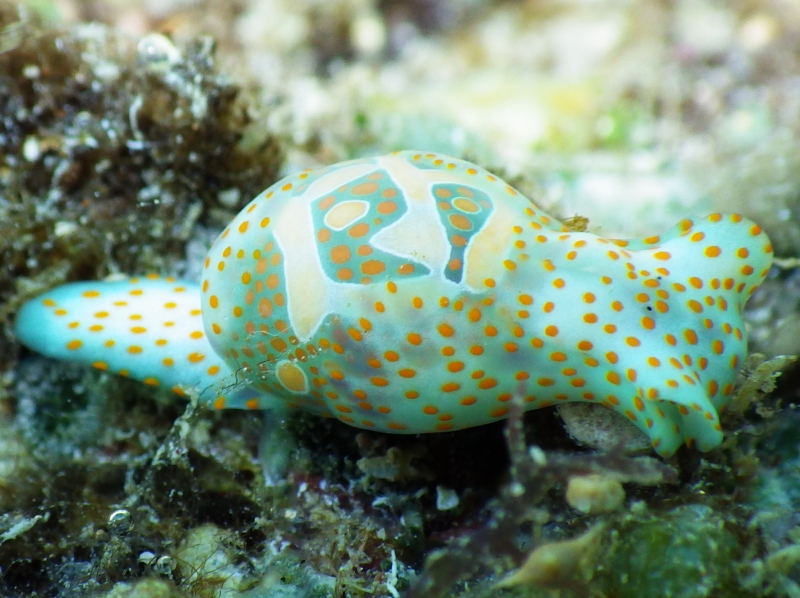
Haminoea cymbalum
> Length: 2cm
> Distribution: Indonesia to Hawaii.
> Description: A very beautiful shelled sea slug that is fairly uncommon, but when found it is usually in large aggregations down to 20m of water
Atys debilis
> Length: 1cm
> Distribution: Kwon from hawaii.
> Description: The atyds mainly inhabit sandy substrates where they use the specially adapted flattened headshield to burrow through the sand for food like small crustaceans.
Navanax inermis
> Length: 22cm
> Distribution: California.
> Description: Like all members of this family, this species is a voracious carnivore, feeding on various shelled species of Bulla and Haminoea. Premating ritual involves the animal's rubbing alongside each other, forming a tight circular embrace.

Navanax aenigmaticus
> Length: 7.5cm
> Distribution: Baja California to Panama and Galapagos.
> Description: The blue spots bordering the margins of the parapodia easily distinguish this species. All Aglajids have an internal shell that is never exposed. The genus Navanax is restricted to the Eastern Pacific. Although it occurs in the Galapagos Islands, it is relatively uncommon

Navanax polyalphus
> Length: 4.5cm
> Distribution: Central California to the Sea of Cortez.
> Description: The profusion of white spots are the origin for the name polyalphus. Not as common as Navanx inermis

Chelidonura amoena
> Length: 5cm
> Distribution: Eastern Indian Ocean, South China Sea to Hawaii.
> Description: Often found crawling on coral during daylight hours
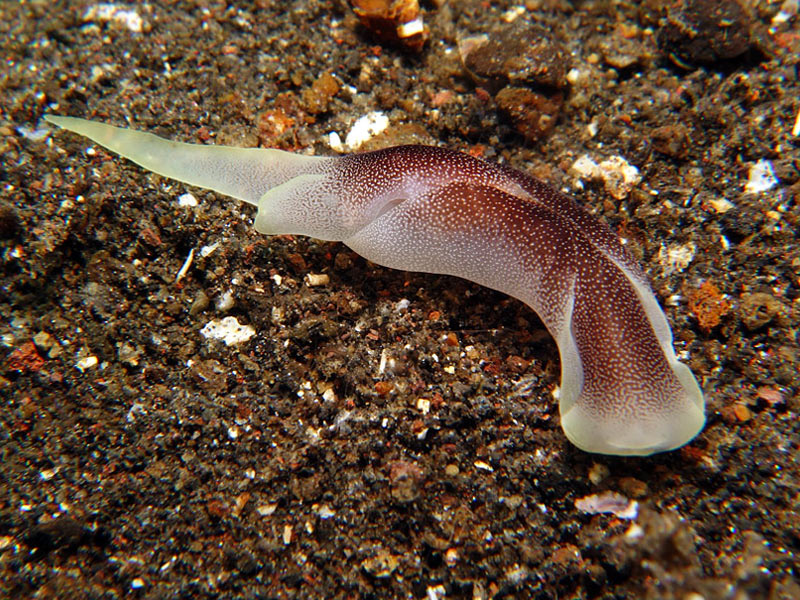
Chelidonura castanea
> Length: 2.5cm
> Distribution: Maldives to Thailand.
> Description: This is a recently described Maldivian species, named for its chestnut brown colouration
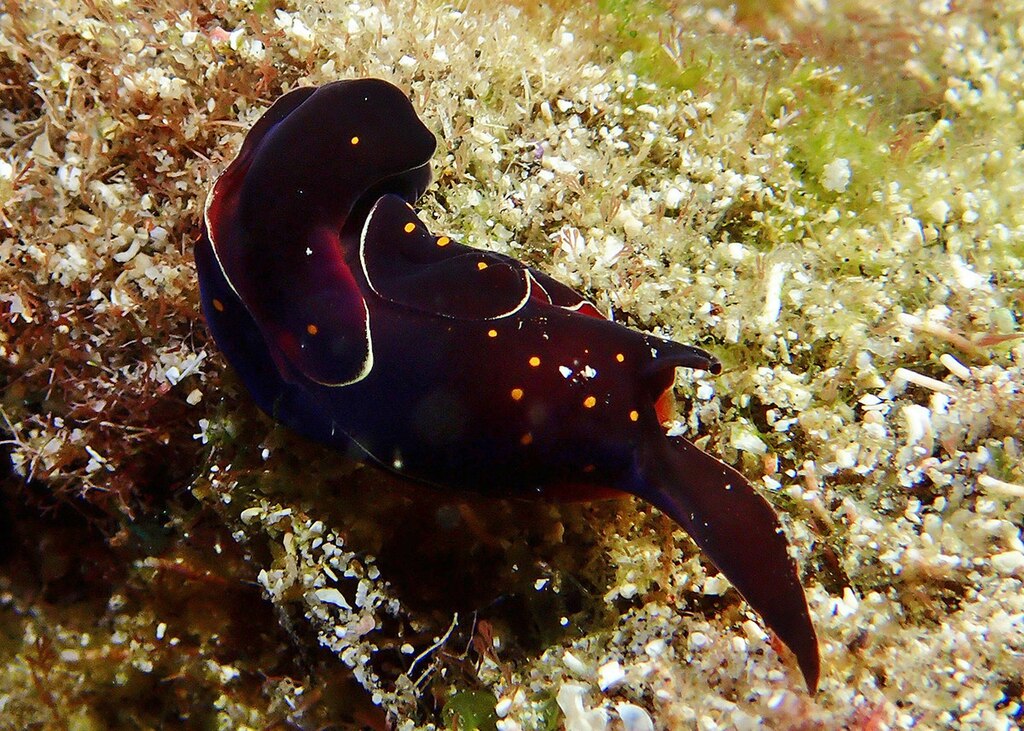
Chelidonura electra
> Length: 7cm
> Distribution: Solomon Is. to East Australia and Indonesia.
> Description: Named after the Greek Goddess Electra, which means 'the bright or brilliant one'

Chelidonura flavolabata
> Length: 5cm
> Distribution: Red sea endemic.
> Description: Easily recognised by its midnight blue colouration and the two yellow lateral head lobes. When disturbed the sea slug lifts the front part of its body and waves it about

Chelidonura fulvipunctata
> Length: 2.5cm
> Distribution: South Africa to Australia, Guam and Hawaii.
> Description: Just behind the head is a mark similar to a 'w' that characterises this species

Chelidonura inornata
> Length: 4cm
> Distribution: Indonesia to tropical Australia.
> Description: By following mucous trails, Chelidonura is able to track prey and locate potential mating partners

Chelidonura pallida
> Length: 3cm
> Distribution: Indonesia to Australia.
> Description: An easily distinguished species that may have a broken black parapodial band
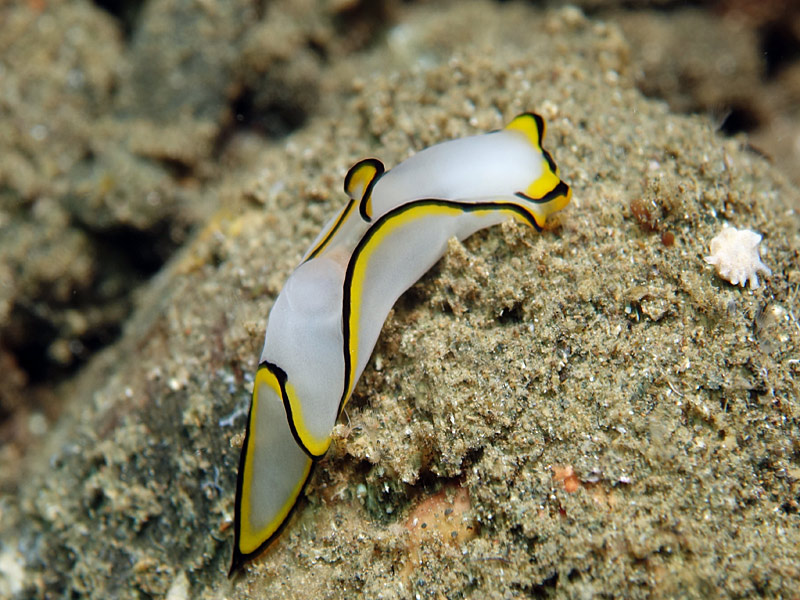
Chelidonura livida
> Length: 5cm
> Distribution: Red Sea Endemic.
> Description: The egg mass of this species looks as if it were a cocoon enveloping the sea slug
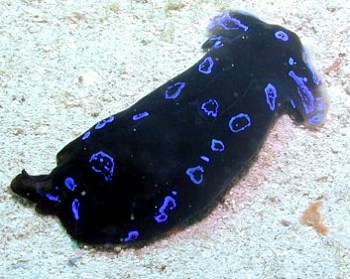
Chelidonura hirundinina
> Length: 2cm
> Distribution: Circumtropical.
> Description: The colour of this sea slug is very variable. It can readily be distinguished by the T-shaped marking on its head. It is rarely found on sand, prefering rocky substances
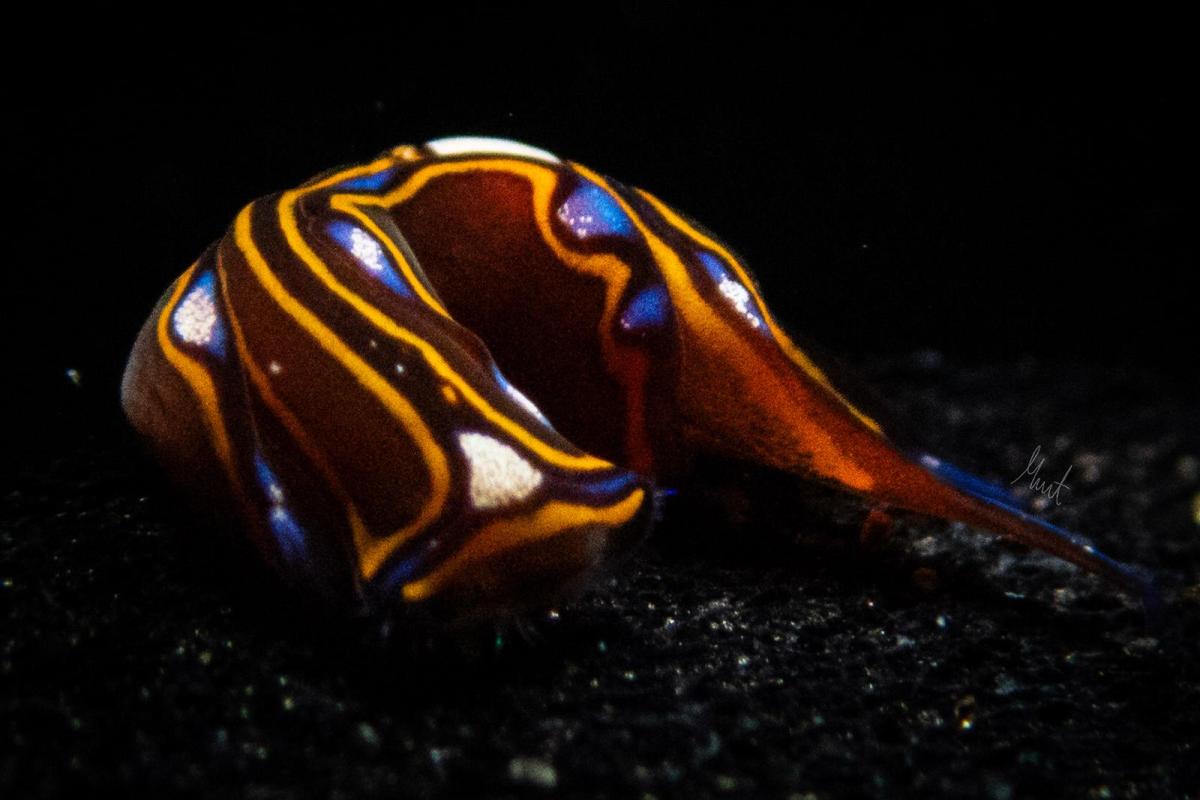
Chelidonura punctata
> Length: 2cm
> Distribution: Tanzania, Madagascar, Mauritius and Thailand.
> Description: This species, like all members of this genus, has two tails, one of which is always shorter than the other

Chelidonura sandrana
> Length: 2cm
> Distribution: Red sea, Maldives and Western Australia.
> Description: Compared to other members of this genus, Ch. Sandrana has one well-developed tail, but the other is just a small knob.

Chelidonura tsurugensis
> Length: 2cm
> Distribution: Indo-west pacific.
> Description: Originally described from Japan.

Chelidonura varians
> Length: 3cm
> Distribution: Indoneisa, Australia to Fiji.
> Description: Not to be confused with C. Livida, which has small blue rings. This species has blue lines, with one in the center of the head being the most distinguishing character

Philinopsis cynanea
> Length: 4.5cm
> Distribution: South Africa, Tanzania, Red Sea, Australia, Indonesia, Philippines.
> Description: The color variability of this species is legendary. It ranges from purplish black to animals with light patches of brown. However, the blue edging on the parapodia is always consistent. The genus Philinopsis has both posterior lobes of the same length, but very short compared to Chelidonura
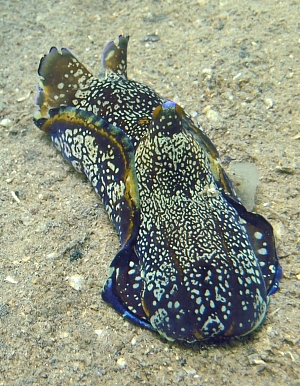
Philinopsis gardineri
> Length: 4cm
> Distribution: Philippines, Indonesia to Australia.
> Description: Not to be confused with Ch. varians; this species does not have a blue line in the center of the head

Philinopsis pilsbry
> Length: 4cm
> Distribution: Thailand, Indonesia and Australia.
> Description: A rare species often only encountered as individuals. The patterning of this sea slug readily identifies it

Philinopsis lineolata
> Length: 2cm
> Distribution: Both sides of Australia.
> Description: Unusual for the marine environment, P. Lineolata has a dense pattern of transverse bars along the entire length of the body
